Harness Engineering Is the New Prompt Engineering
WalkingLabs' free Learn Harness Engineering course teaches the five-subsystem harness around coding agents: 14 lectures, 8 projects, and why prompts alone fail.

Director of Product, AI at Sprouts.ai
Harness engineering is the practice of building the environment, instructions, tools, state, and feedback loops around a coding model so agents finish real work reliably. Learn Harness Engineering is a free MIT curriculum from WalkingLabs with 14 lectures and 8 projects. Better prompts help at the margins. The system around the model decides whether an agent ships something you can trust.
What is Learn Harness Engineering?
The public repo is walkinglabs/learn-harness-engineering, with about 22,191 GitHub stars at writing time, and docs at walkinglabs.github.io/learn-harness-engineering. The README lists 14 lectures, 8 projects, 15 language editions, and an MIT license.
It is not a new agent runtime. It is a project-based course on making agents you already use (Claude Code, Codex, Cursor, and similar) fail less on multi-session engineering work. Lectures explain why strong models still break on real repos. Projects rebuild one Electron app while you add harness pieces from a prompt-only baseline through loops and a first workflow graph.
Why do prompts alone fall short?
Anthropic's harness design for long-running apps gave Opus 4.5 the same prompt for a 2D retro game maker with and without a full harness. The solo run lasted about 20 minutes and cost about $9, with a broken playable path. The full harness (planner, generator, evaluator) ran about six hours, cost about $200, and produced a playable game. The model stayed the same. The surrounding system changed.
OpenAI's Harness engineering essay treats the repository as the system of record: keep AGENTS.md as a short map into deeper docs, encode invariants in linters and tests, and expose logs, UI, and verification the agent can run without pasted context. Anthropic's effective harnesses for long-running agents adds the session problem. Each new context window arrives blank, so progress files, feature lists, git history, and clean handoffs become load-bearing.
Related reading on this site: YC QM, NVIDIA OpenShell, and Kiro Crew.
What are the five subsystems?
Lecture 02 defines a harness as five subsystems outside the model weights: instructions, tools, environment, state, and feedback.
Instructions are the map the agent reads first (AGENTS.md or CLAUDE.md, plus links into docs/), not a thousand-line dump. Tools are the shell, browser, and package commands it may use under least privilege. Environment is the reproducible runtime (lockfiles, version pins, containers, init scripts). State is durable progress on disk so the next session does not guess. Feedback is verification the agent runs itself: tests, lint, type-check, smoke, and end-to-end checks listed as explicit commands.
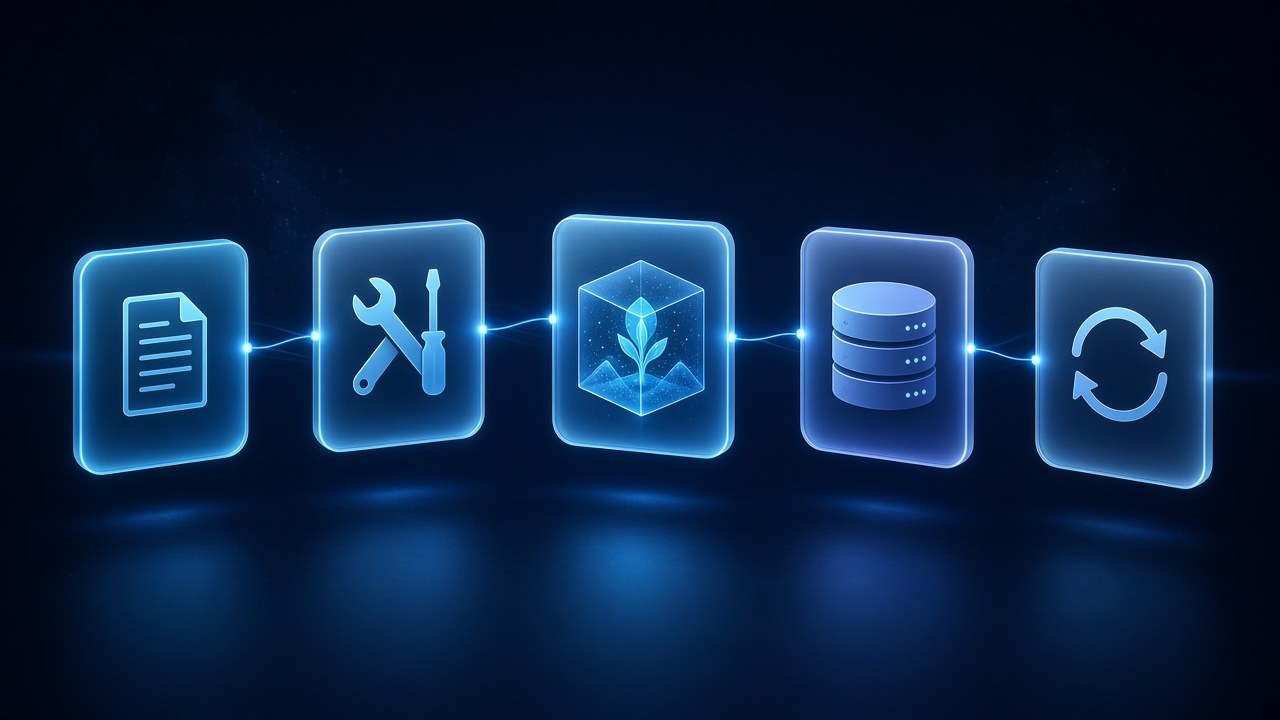
The course also stresses verification gates, one-feature scope, and a clean session lifecycle. Drop a subsystem and familiar failures show up: lost continuity, overreach, or a confident "done" with no proof.
How is the curriculum structured?
Fourteen lectures cover failure modes, repository-as-truth, progressive disclosure, continuity, initialization, scope, feature lists, early victory, end-to-end testing, observability, clean state, loops, and graphs.
Eight projects apply those ideas to one Electron app: prompt-only vs rules-first, agent-readable workspace, multi-session continuity, runtime feedback and scope, self-verification, a full-harness capstone, maker-checker loops, and an explicit workflow graph.

Templates ship in a resource library (AGENTS.md, feature_list.json, init.sh, loop prompts), plus tools/audit-harness.sh for a shell-based harness audit without Node.
Where should builders start?
If you ship coding or agent products, try this path:
Skim Lecture 02 and the OpenAI and Anthropic essays above.
Run Project 01: same task, prompt-only, then with a minimal harness.
Add four files to one real repo: a short
AGENTS.md, a progress log, a machine-readable feature list, and aninit.shthat boots and smoke-tests the app.Put verification commands in the instruction file and refuse to mark work done until they pass.
When one session is no longer enough, try Project 07's loop patterns before inventing a custom multi-agent graph.
The course is free under MIT. Use it as a checklist for the product harness you are already building.
Frequently asked questions
Is this a new coding agent?
No. It is a curriculum and template library for the environment around agents you already run.
Do you need Claude Code specifically?
No. Projects are written so Claude Code, Codex, Cursor, and similar tools can complete the tasks inside each starter/ workspace.
How long is the course?
14 lectures and 8 progressive projects on the same Electron app, plus a resource library and PDF build pipeline.
What license is it under?
MIT License (Copyright WalkingLab).
Sources

Kartikay Dhar
Director of Product, AI at Sprouts.ai, where he leads the team behind Sprouts Data Intelligence, its Agentforce app and its MCP server. On Instagram he shares one free GitHub repo a day.
Stay in the loop
Get notified when I publish new articles and projects.