What Amazon Kiro Crew Means for Async Agents
Kiro Crew is AWS Kiro's open-source async agent workspace: schedules, memory, approvals, and audit logs so coding agents keep working after you leave.
Kiro Crew is AWS Kiro's open-source workspace for coding agents that keep working after you close the chat. Schedules, shared memory, approvals, and a signed audit trail run on hardware you control.
The usual stuck point with agent tools is that you become the glue: reconnect context, restart the job, stitch the handoffs. Kiro Crew is built so that glue lives in the workspace instead of in your head.
What is Kiro Crew?
Kiro Crew is a Python project under Apache License 2.0 from Amazon's Kiro team. The public repo is github.com/kirodotdev/KiroCrew, with about 4,608 GitHub stars at the time of writing. It began inside Amazon as MeshClaw: kick off a task, walk away, come back to something worth reviewing, with the security controls Amazon required for internal use that lighter OpenClaw-style tools did not offer.
According to the launch post on kiro.dev, internal adoption reached more than 39,000 Amazon builders, with nearly 500 contributors shipping 597 updates at about 143 weekly commits. The open release keeps that model: desktop app, web dashboard, TUI, plus Slack, Telegram, and Discord, running locally or on a remote host you control.
How does async crew orchestration work?
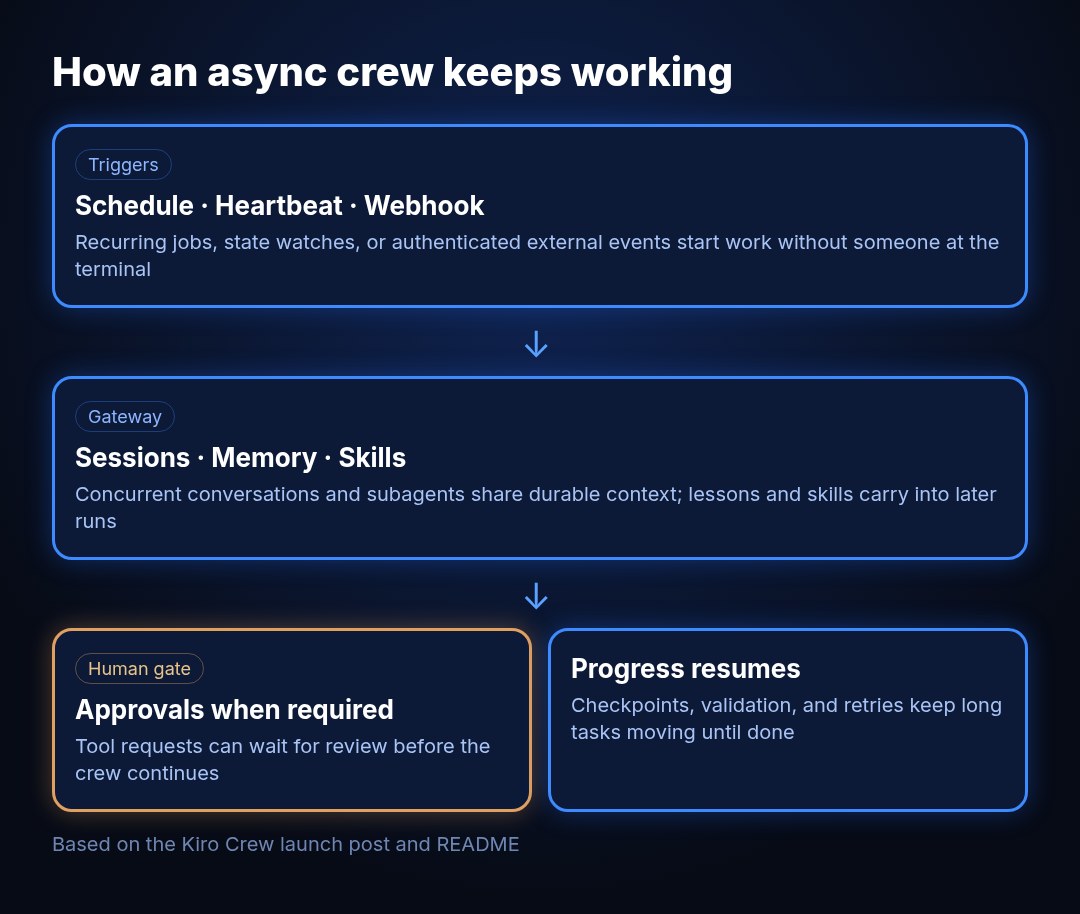
Kiro Crew's Gateway keeps sessions, memory, schedules, and task checkpoints alive across restarts. You can hand it a ticket queue to triage, point it at an incident across repos, or start a migration that moves through checkpoints and retries while you are in a meeting or asleep.
Recurring jobs run on schedules you define. A morning digest can collect what needs review. A heartbeat can watch a pull request or deployment until state changes. An authenticated webhook can start work when an external event arrives. Jobs that do not need reasoning can run as plain scripts or commands without a model call.
For work that benefits from more than one agent, you can run concurrent conversations with isolated context, or spawn subagents that return results to a parent conversation. Agents carry preferences, project context, and history through memory. Corrections become durable lessons. Repeated patterns become reusable skills you can inspect, edit, or remove. Claude Duet also keeps work moving after you leave a session; Kiro Crew puts schedules, approvals, and a full workspace around that same idea.
What security and approvals ship with it?
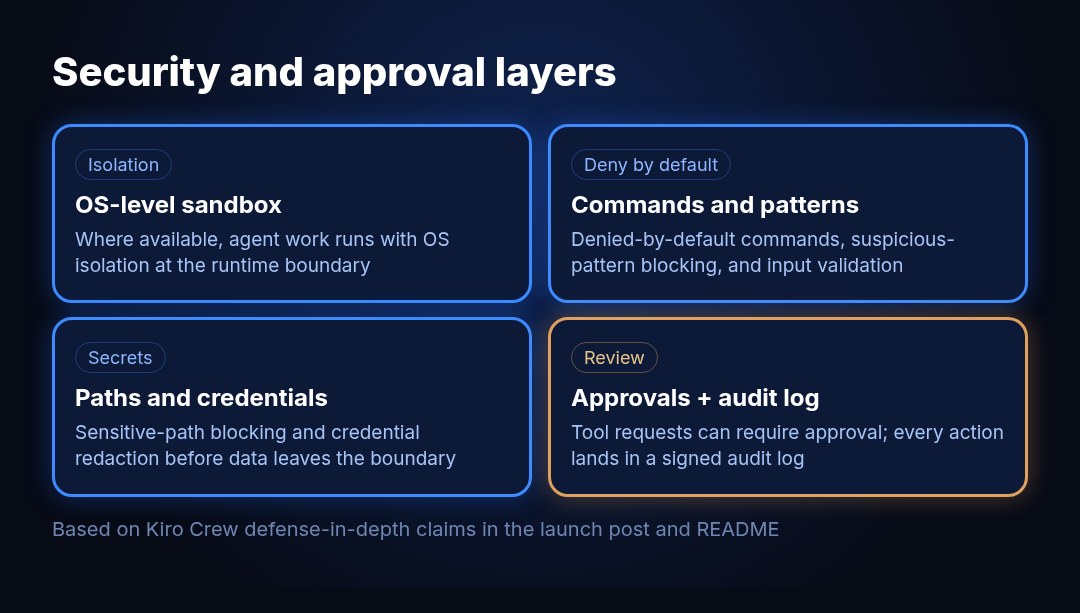
The launch post and README describe defense in depth for a workspace that can touch code and CI: an OS-level sandbox where available, denied-by-default commands, suspicious-pattern blocking, input validation, sensitive-path blocking, credential redaction, and a signed audit log of every action. Tool requests can require approval. The dashboard binds to loopback by default; remote exposure needs authenticated configuration.
Orchestration runs behind Agent Client Protocol (ACP). The Activity view shows each agent's reasoning, tool calls, and results live, one card per agent. You can watch how it plans a task, spawns parallel sub-agents, gates actions for approval, and synthesizes results. Sandbox-first runtimes such as NVIDIA OpenShell push a similar idea further by applying kernel-level policy to agent processes.
How do you run and extend it?
Install paths include a desktop app with auto-updates for macOS, Windows, and Linux; a one-line signed wheel install; Docker on GHCR for always-on servers; and a source build. The default agent backend is kiro-cli, which you install and sign in to separately. If you already use Kiro, Crew reads existing .kiro configuration so steering files, skills, and custom agents carry over.
curl -fsSL https://download.\
crew.kiro.dev/cli.sh | sh
# then open http://localhost:5476
Apps add purpose-built interfaces on top of agents, skills, schedules, and MCP. At launch: DevFleets for work trees, Task Runner for long jobs, Issue Radar for issue and PR triage, plus an App SDK. Governance is public: maintainers are listed in MAINTAINERS.md, proposals land as pull requests, and the project states it will accept integrations even when they do not map to Kiro's own product strategy.
Frequently asked questions
Is Kiro Crew only for Amazon employees?
No. It started as MeshClaw inside Amazon and is now open source under Apache 2.0. Anyone can clone the repo, install the desktop app or CLI, or run the Docker image on hardware they control.
Does it only work with the Kiro CLI?
At launch the default ACP backend is kiro-cli, and existing .kiro config carries over. The README also points to other verified ACP harnesses with their own prerequisites in the install guide.
Does Kiro Crew send telemetry?
Yes, one anonymous daily heartbeat by default (instance id, app version, Python minor, install path, and a first-send flag), plus optional official-app install receipts. Prompts, file contents, credentials, and hostnames are not sent. You can disable it in Settings or with kirocrew telemetry disable.
What license is it under?
Apache License 2.0.
Sources
Stay in the loop
Get notified when I publish new articles and projects.