What Claude Duet Gets Right About Proactive AI Agents
Claude Duet is Anthropic's proactive agent: morning briefs, background work and approval before it acts. What it gets right, and what revenue agents still need.

Claude Duet is a research-preview app from Anthropic in which Claude works as a proactive agent. It sends you a morning brief, checks your connected apps every few hours, keeps working on tasks in its own cloud virtual machine while you're away, and asks for your approval before it sends a message, makes a payment, signs a document or deletes anything. It runs on Claude Opus 5.5 and opened by waitlist on October 21, 2026, for Pro and Max subscribers in the US.
Almost every agent I use still waits for me to type something. Claude Code, Codex and the chat apps all start with my prompt. Duet starts with its own message: here's what needs you today, and here's what I already drafted.
What is Claude Duet?
Anthropic describes Duet as "a new app where Claude works as a proactive agent. It comes to you with what needs your attention, completes tasks you ask of it, keeps working even when you step away, and checks with you before it acts on your behalf." It's built for "professionals and small business owners with more on their plates than they can track."
It's a standalone app on iOS and Android and on claude.ai, separate from the main Claude app for now. During the preview it's included in the Pro and Max plans at no extra cost and draws on the same usage limits. You can't pick a model. Duet runs on Claude Opus 5.5 and decides how much effort a job needs.
How does Claude Duet work?
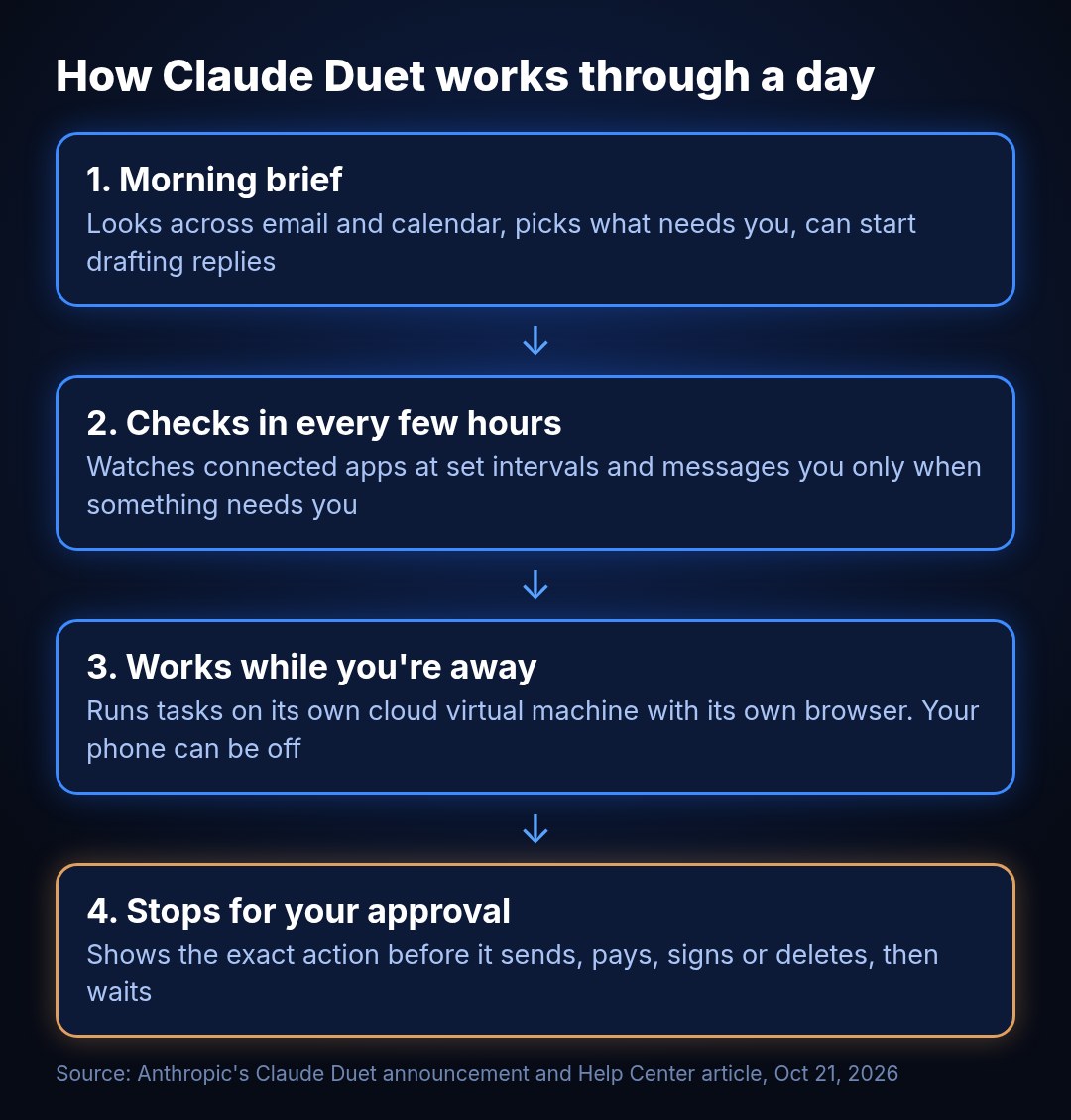
Duet starts from the context you've already given Claude. It carries over your memory, skills and connected apps from your Claude account, so there's very little setup. You talk to it in one ongoing thread, by typing or by voice, and you can open separate channels for different topics that share the same memory.
Each morning it looks across your email and calendar, picks what most needs your attention and can start on the first steps, such as drafting replies for you to review. Through the day it checks your connected accounts every few hours. Anthropic is open about why it doesn't check constantly: "checking nonstop would use up your plan's limits much faster."
When you hand it a task, it works out which apps to use and runs the steps in the background on a virtual machine with its own browser, so your laptop or phone can be off. For sites without a connector, it uses that cloud browser. A Tasks tab shows what it's working on, larger results such as a research brief, a financial model, a slide deck or a dashboard land in a Make tab, and only you can mark a task as complete.
Duet can use the more than 6,000 connectors and plugins in the Claude Marketplace. Anthropic's examples include finding missed Gmail and Slack messages, checking QuickBooks or Stripe for unpaid invoices, running payroll in Gusto, sending agreements through Docusign and drafting follow-up emails from HubSpot deal history. It can also buy things for your business through Stripe's Link or Shopify's Shop Pay, with a one-time card for each approved purchase.
What does Claude Duet do before it acts?
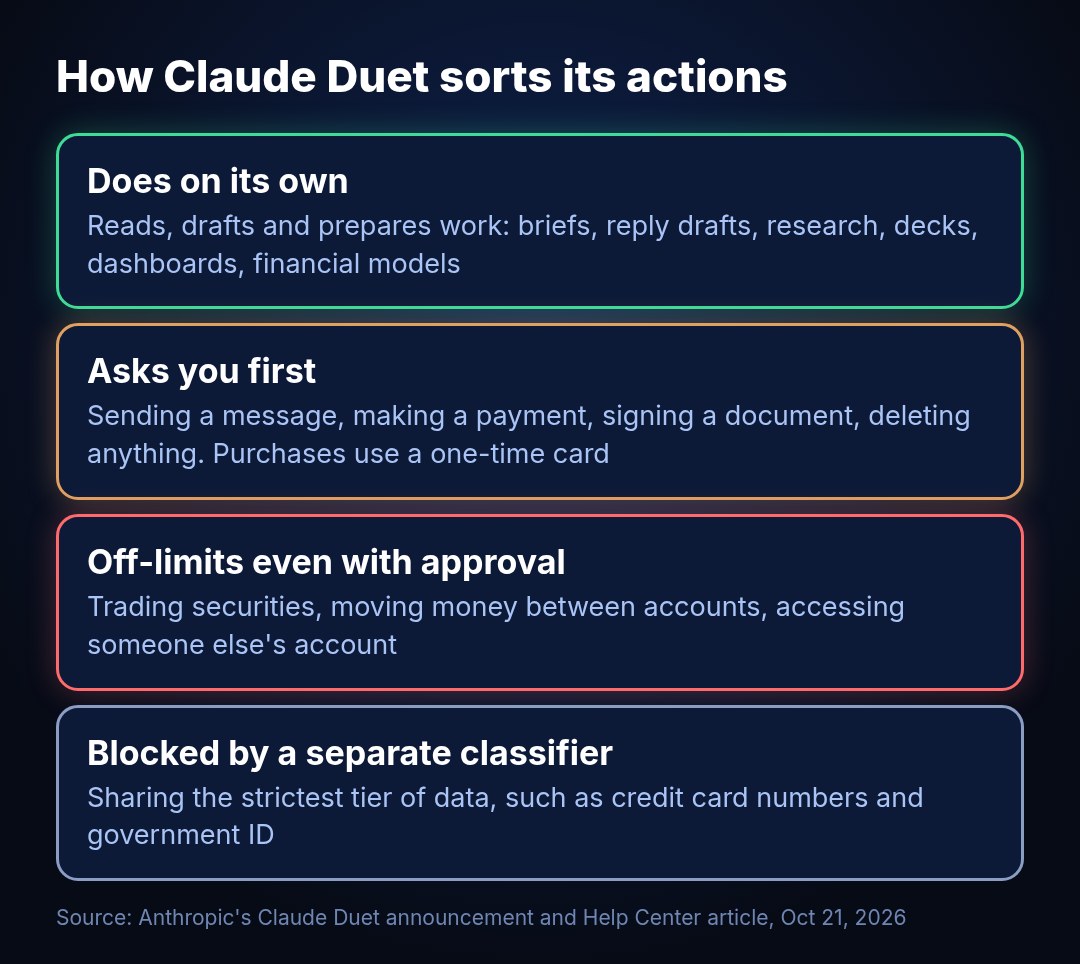
This is the part I'd study even if you never use Duet. Anthropic draws three lines around actions.
Duet reads, drafts and prepares work on its own. Before it sends a message, makes a payment, signs a document or deletes anything, "it shows you exactly what it's about to do and waits for your approval." If you can't approve right away, it finishes the rest of the task and brings the approval back later. A few actions are off-limits even with your approval: trading securities, moving money between accounts and accessing someone else's account.
Sensitive data gets its own check. Anthropic is shipping Duet with a dedicated classifier and safety system prompt that reviews each message. It rejects requests to share the strictest tier of information, such as credit card numbers and government identification. Health or personal finance details go out only when you've explicitly told Duet to send them.
The rest of the safety design reuses earlier work. Credentials follow the design of Claude Managed Agents, so Duet "never directly sees your passwords or sign-in tokens." Actions are approved by the same auto mode classifier that guards Claude and Claude Code. Its prompt-injection defenses come from Anthropic's browser-use research, and Anthropic says red teams and an external firm penetration-tested it. When a site asks for a password, you type it into a separate form on your device that sends it straight to the browser, outside the chat.
The Help Center is honest about the limits of all this. Duet is built to treat what it reads as information, "but no defense is perfect, which is one reason consequential actions need your approval."
What does Claude Duet get right?
The approval list is short and concrete. Send, pay, sign, delete. A rep or a founder can remember that without reading a policy, and it covers the actions that hurt when an agent gets them wrong. In my post on YC's QM I liked that QM keeps approval decisions out of the agent's reach. Duet applies the same idea to a consumer product.
It also shows its sources. When Duet gives you a number or a summary, the Help Center says "it tells you which email, file, or spreadsheet it came from." For revenue work, that means a rep can check a deal update in one click before acting on it.
And it's upfront about cost. The interval checks exist because constant polling burns usage, and background work like the morning brief counts toward your limits. Anthropic even gives preview users one full limit reset, available until November 30, 2026.
I also like that it comes to you first. That's the shift I care about for product teams. In Why the Agent Stack Is the Real Revolution I wrote that skills are the brain and MCP is the hands. Duet adds a schedule and a sense of what deserves your attention, which is what turns those parts into something you'd hand a morning to.
What would a revenue team still need from a proactive agent?
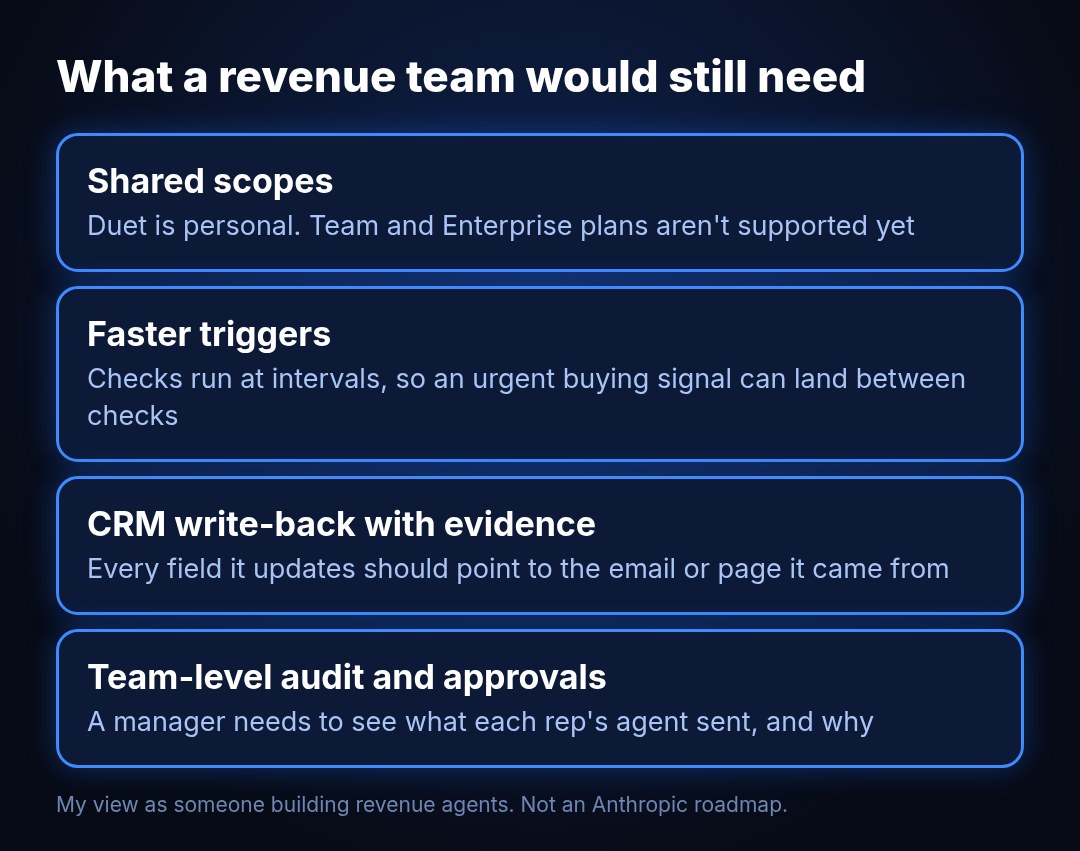
Duet is a personal agent, and Anthropic says so. It isn't available on Team or Enterprise plans yet, though the Help Center says Anthropic plans to bring it there later. From where I sit, building agents for sales and marketing teams, four gaps stand out.
The first is shared scope. A revenue team works in shared accounts, shared channels and shared pipelines. Someone has to decide which agent remembers what, and whose keys it uses. That's the problem QM tackles with per-person and per-room scopes, and a personal app doesn't need to solve it yet.
The second is timing. Duet checks at set intervals, and the Help Center warns that "something urgent can arrive between checks." That's a reasonable trade for a founder's inbox. For a buying signal, like a target account visiting your pricing page or replying to a sequence, a few hours can be the difference. Revenue agents also need event triggers that fire when the signal arrives.
The third is write-back with evidence. Duet cites its sources when it summarises. A revenue agent also writes to the CRM, and every field it updates should carry the email, call note or page it came from, so a rep can check it in one click.
The fourth is team-level audit. Duet asks one person to approve one action. A sales manager needs to see what every rep's agent drafted, sent and skipped, and why. Connector coverage is still growing too. Microsoft 365 isn't available yet, and some connectors such as Slack work with limits.
How would I test a proactive agent before trusting it?
I started my career writing test automation, and I'd test Duet, or any proactive agent, the way I'd test a release. A few cases I'd run in the first week:
Plant an email with hidden instructions and check that Duet treats it as information and doesn't act on it.
Compare every approval card with what actually happened afterwards. The card has to match the action exactly.
Click through the cited sources on numbers in the brief. A wrong citation is worse than none.
Send something urgent right after a check-in and note how long it takes to surface.
Count the messages that didn't need you. If the agent interrupts too often, people stop reading it.
Anthropic itself says this early version "might misread a thread or miscalibrate what's urgent." A test plan turns that warning into something you can measure.
How do you get Claude Duet?
You need a Claude Pro or Max plan, a Claude account in the US and an invitation from the waitlist. You join from the Claude Duet product page with the email on your Claude account, and invitations go out in waves. Access is tied to that email, so use the Apple or Google account on your phone that matches it.
That means readers in India, like me, can't use it yet. I'm still watching it closely, because the approval and sourcing patterns apply to any agent we build, whichever model sits underneath. If you're building agents for your own team, which of Duet's lines would you copy first: send, pay, sign or delete?
Frequently asked questions
Is Claude Duet free?
During the research preview, Claude Duet is included with the Pro and Max plans at no extra cost. It uses your plan's usage limits, including background work such as the morning brief and check-ins, so you may hit your limits sooner than with chat alone.
Which model does Claude Duet use?
Claude Duet runs on Claude Opus 5.5. You can't choose a different model, and Duet decides how much effort each job needs.
Can Claude Duet act without my approval?
It reads, drafts and prepares work on its own. Before it sends a message, makes a payment, signs a document or deletes anything, it shows you the exact action and waits for approval. Trading securities, moving money between accounts and accessing someone else's account are blocked even with approval.
Is Claude Duet available on Team or Enterprise plans?
Not yet. Anthropic says it plans to bring Duet to Team and Enterprise plans later. The preview is limited to Pro and Max users in the US.
Can I use Claude Duet in India?
Not during the research preview. Access requires a Claude account in the US, along with a Pro or Max plan and a waitlist invitation.
How is Claude Duet different from regular Claude?
Regular Claude responds when you message it. Duet reaches out first with a morning brief and check-ins, runs tasks in the background on its own cloud computer, and keeps a Tasks tab of work in progress. It uses the same memory, skills and connectors as your Claude account.
Sources
Stay in the loop
Get notified when I publish new articles and projects.