Decisions API vs Jev vs Laya vs Cloudflare Clef
OpenAI's Decisions API, TypeSafe's Jev, open-source Laya and Cloudflare's Clef all return typed decisions. Here's how they compare on price, inputs and hosting.

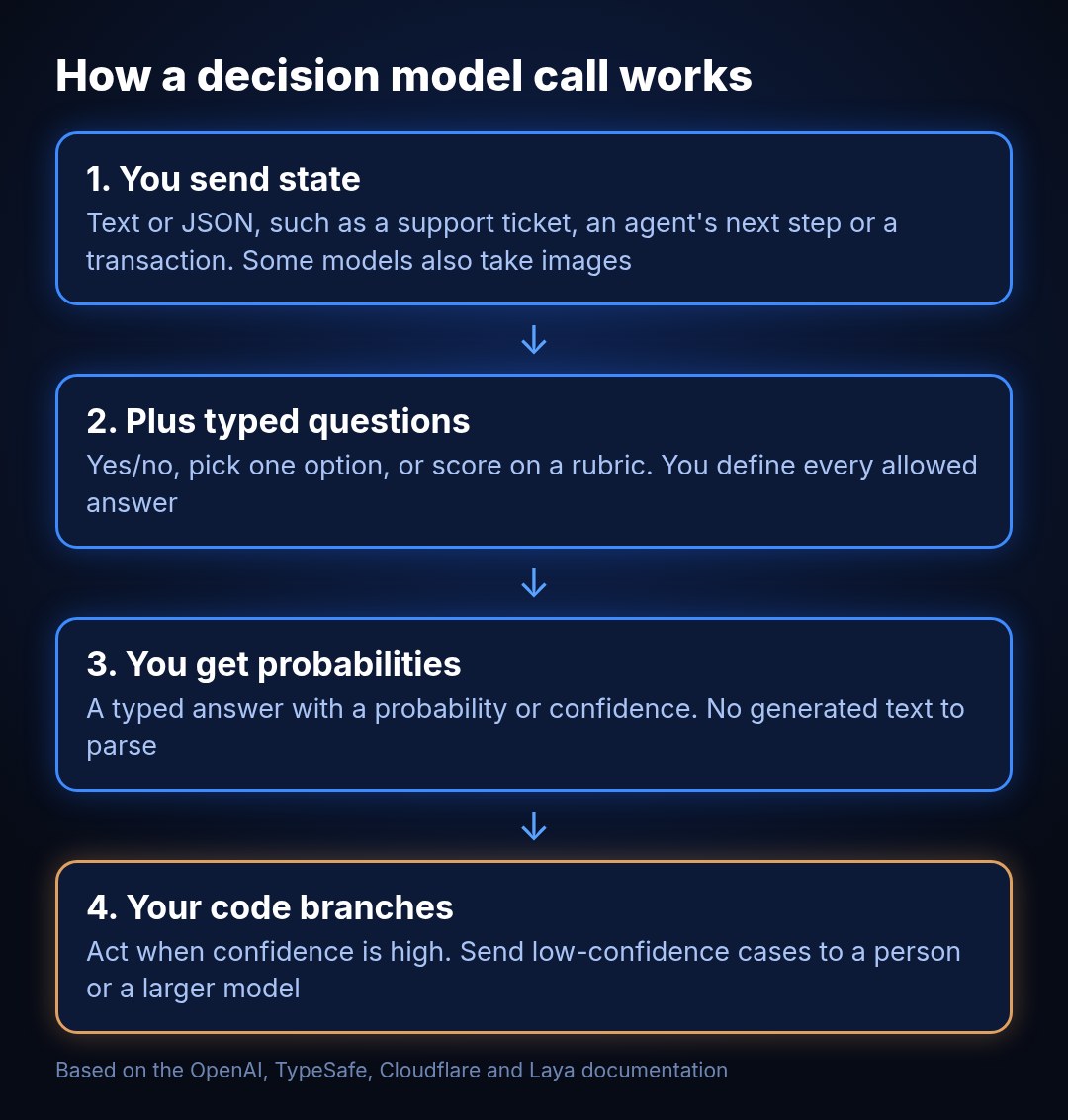
A decision model answers a fixed question about some input and returns a typed answer with a probability, instead of generating text. OpenAI's Decisions API, TypeSafe's Jev, Cloudflare's Clef and the open-source Laya all work this way: you send state and questions with predefined answers, and get back a choice, a yes/no probability or a score that code can branch on. They differ on price, inputs and hosting.
What are these four decision models?
Jev, from TypeSafe AI, started the category. TypeSafe calls it a "System One" model. It reads text, JSON objects or arrays of text, and answers three question types: Choice, Score and Noul (a yes/no probability). Jev 1.14 became available on October 14, 2026.
OpenAI's Decisions API became generally available on October 22, 2026, built with GPT-6 Luna. Its three answer types are predicate, choice and score. It takes text, images and native JSON, and allows up to 400 questions per request.
Cloudflare's offering is the Clef family on Workers AI, announced October 1, 2026: Clef, a 27B model, and Clef-flash, a 9B model. Both read text, JSON, images or video, accept 1 to 64 questions per request and use the same request format as Jev. Cloudflare released the weights on Hugging Face under Apache 2.0.
Laya is an open-source project on GitHub (NandhaKishorM/laya, Apache 2.0) with checkpoints published by Convai Innovations. It uses small encoder models, a 421M ModernBERT-large for English and a 322M mmBERT-base for 100+ languages, and its laya-serve server exposes the same /v1/systemone endpoint as Jev.
How do they compare?
| Model | Price per 1M input tokens | Inputs | Where it runs |
|---|---|---|---|
| OpenAI Decisions API | $0.10 ($0.01 cached) | Text, JSON, images | OpenAI API, US or EU processing |
| TypeSafe Jev | $0.042 | Text, JSON | TypeSafe API |
| Cloudflare Clef | $0.24 | Text, JSON, images, video | Workers AI or open weights |
| Cloudflare Clef-flash | $0.038 | Text, JSON, images, video | Workers AI or open weights |
| Laya | Free to self-host | Text, JSON | Your own CPU or GPU |
No hosted option charges for output tokens. Context: Jev allows 64k tokens per request and 32k per question, Clef 65,536 tokens and Clef-flash 24,576.
How fast are they?
Every speed figure here comes from the vendor or project, so treat them as claims. OpenAI says Decisions is up to 10x faster than GPT-6 Luna through the Responses API. TypeSafe says Jev's end-to-end response time is 70 to 500 ms. Laya's README reports 33 ms for one question on a T4 GPU.
Cloudflare ran one benchmark across several of these models and reported median latency of 209.3 ms for Clef, 38.8 ms for Clef-flash, 524.1 ms for Jev and 5.8 ms for Laya. The same post says Laya trades away quality for that speed, scoring far lower than the others on Cloudflare's tests. Laya's authors report that a fine-tuned Laya checkpoint beat Jev 1.13 on the typed-decisions benchmark (0.766 vs 0.727 accuracy), using Jev's published figures. The two results use different tests, so they don't line up directly.
Which one fits which job?
The Decisions API fits teams already on OpenAI that need image inputs, many questions per call, US or EU data residency, or decisions inside GPT-Live voice sessions.
Jev fits text-only decisions, such as ticket routing or agent gating, where low input price matters and a hosted API is fine.
Clef fits teams on Cloudflare, image or video workloads, and anyone who wants hosting with the option to self-host the open weights. Clef-flash is the cheapest hosted option listed here.
Laya fits teams that want decisions on their own hardware at no per-call cost and will fine-tune and test it on their own data first.
All four return probabilities, so the usual pattern is simple: act when confidence is high and route the rest to a person or a larger model. That is the same idea of typed contracts for agents covered in The End of the Visual Web, and it pairs with packaged know-how like Agent Skills.
Frequently asked questions
Is the OpenAI Decisions API compatible with Jev?
Not directly. OpenAI uses its own endpoint and calls its yes/no type "predicate", while Jev, Clef and Laya share the /v1/systemone format with Choice, Score and Noul questions.
Which decision model is cheapest?
Among the hosted options, Cloudflare Clef-flash lists $0.038 per million input tokens and Jev $0.042. Laya has no per-call price because you run it yourself.
Can these models read images?
The Decisions API, Clef and Clef-flash accept images, and Clef also reads video. Jev and Laya take text and JSON but not images.
Are any of them open source?
Clef and Clef-flash weights are on Hugging Face under Apache 2.0, and Laya is Apache 2.0 on GitHub. The Decisions API and Jev are closed, hosted services.
Sources
Stay in the loop
Get notified when I publish new articles and projects.